The role of businesses in halting deforestation
Deforestation and conversion of land are significant contributors to climate change. Businesses play a critical role in global sustainability efforts to protect landscapes to mitigate the pace of climate change and biodiversity loss while protecting livelihoods.
The challenge of closing the gap on deforestation-free supply chains
There is increasing pressure on achieving deforestation and conversion-free (DCF) commitments as a myriad of regulations are in place or are coming into force, from the EU Deforestation Regulation (EUDR) to the Science Based Targets initiative (SBTi) Forest, Land, and Agriculture (FLAG), which require companies to act.
While regulations set clear goalposts, the pathways to reach DCF supply chains are less clear. While efforts over the last two decades have made progress, we’ve seen certification and traceability progress plateau with businesses struggling to close the gap on reaching 100% DCF supply chains. Alternative pathways to DCF therefore need to be explored, but guidance on this has previously been limited.
New AFi guidance brings clarity
At 3Keel, we’ve been working with companies for over 10 years to support them in setting their deforestation ambitions and helping them reach them through engaging their suppliers, mapping supply chains and co-ordinating collective efforts.
In December 2025, the Accountability Framework initiative (AFi) launched new Operational Guidance on Commitments and Progress Pathways, bringing much-needed clarity to the challenges businesses face. 3Keel (through the Retail Soy Group) helped shape these.
We’re very pleased to share that, as of June 2026, 3Keel is now an official delivery partner of the AFi.
Why we use AFi guidance
The Accountability Framework sets out what best practice looks like to achieve ethical supply chains that protect forests, natural ecosystems and human rights. It serves as an industry standard that guides companies in setting, implementing and monitoring effective commitments on deforestation, ecosystem conversion and human rights. It’s a great reference point for ensuring due diligence approaches are fit for purpose by credibly delivering on responsible commodity sourcing ambitions.
The latest updates are pragmatic in recognising the reality of traceability challenges, particularly for those more complex supply chains. We’ve already put them into practice with clients who are now thinking beyond 2025 when it comes to deforestation policies and methodologies.
Commitments and ‘progress pathways’: five key clarifications from the AFi’s latest operational guidance
Below are some of the most significant changes from the newly refreshed operational guidance.
1. More frequent updates on progress are necessary
The concepts of “Progress Pathways” and “Milestones” recognise the imperative for more frequent updates and transparency on the progress that companies are making. They also provide businesses with flexibility in how they reach these targets and goals. We see this as a significant shift.
Previously, it was possible for companies to set commitments and report on these commitments years afterwards, with minimal updates between commitment setting and the planned goal end-date.
2. Transparency is rising in importance
A common thread throughout the guidance is the increased expectation of transparency and specificity. Companies need to explain their action plan (for example, giving clear justifications for phasing and priorities) and disclose progress (this includes if there has been a missed target date, with an explanation why).
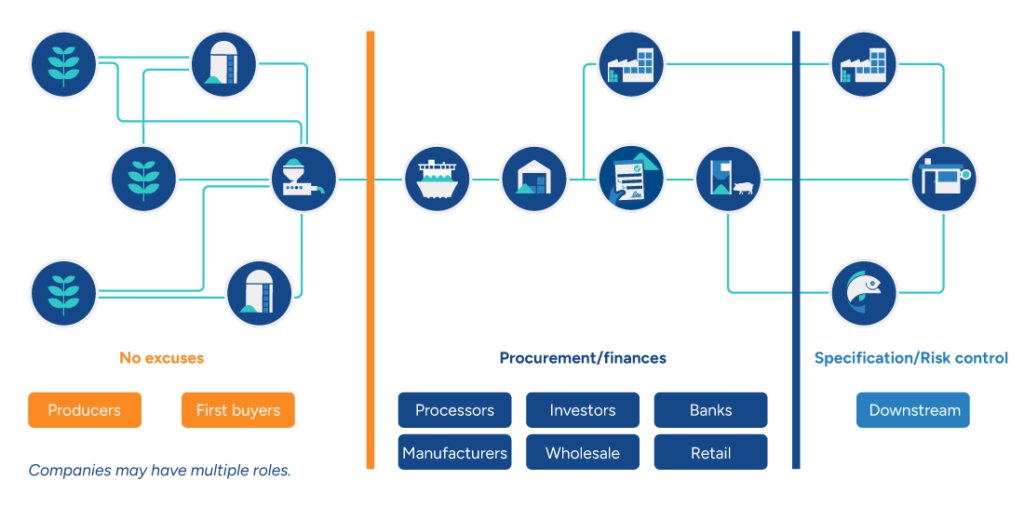
3. Expectations differ depending where a company sits in the supply chain
The guidance covers increased details on how requirements differ depending on where a company sits in the supply chain, recognising the challenges the further away from the source of materials. See the illustration below for a visual overview.
Expectations differ across the supply chain
4. Risks inform prioritisation and phasing
Phasing should prioritise where impacts and/or risks are greatest – e.g. areas with significant amounts of post-cutoff date deforestation, or areas with significant ongoing human rights violations. A phased approach is not justified if the company has direct control of the commodity production (as per point three).
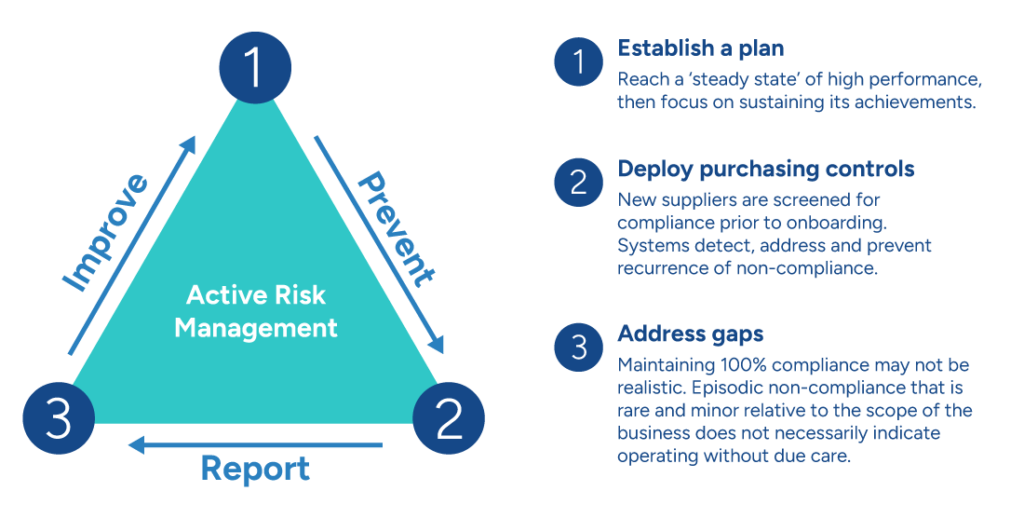
5. Compliance isn’t a one-time achievement
As the diagram below shows, once a ‘steady state’ of high performance has been reached, it is imperative to deploy purchasing controls to ensure compliance and then address any remaining gaps.
Compliance is a continual achievement
If you’d like to learn more about making the AFi’s new forest-risk guidelines work for your business, we hosted a webinar on this topic in March. It dives into the above in much more detail.
“For a number of years, we’ve been involved in the technical working groups supporting the development of enhanced operational guidelines that pragmatically address the needs of downstream companies, while driving real impact for producers upstream,” said 3Keel Co-founder Will Schreiber.
“The unique collaboration between more than 20 environmental and human rights organisations delivers on its promise by having a considered and expert view on what works on the ground.“
Adrienne Brown, Senior Manager at AFi, added: “Our goal at the Accountability Framework initiative is to make responsible supply chains the new ‘business as usual’ for the agriculture and forestry sectors. We do this by working with strong partners like 3Keel, who are directly putting the Framework into practice with companies.
“3Keel’s expertise has proven invaluable to help shape the Framework’s guidance through our working groups, and we’re delighted to have them as an AFi delivery partner, working to embed the Framework’s guidance into the operations and sourcing practices of some of the world’s leading companies.”
Looking ahead
As companies begin to look ahead to 2030 targets, we’ll continue to stay up to speed with the latest guidance from the AFi to provide our clients with best practice advice. In particular, we’re looking forward to further clarifications from the team in 2026, with updated guidance on MRV and supply chain management.
If there are any challenges you’re currently navigating with deforestation policy, commitments, roadmaps or DCF methodologies, do get in touch with our team.