Headline 2025 data
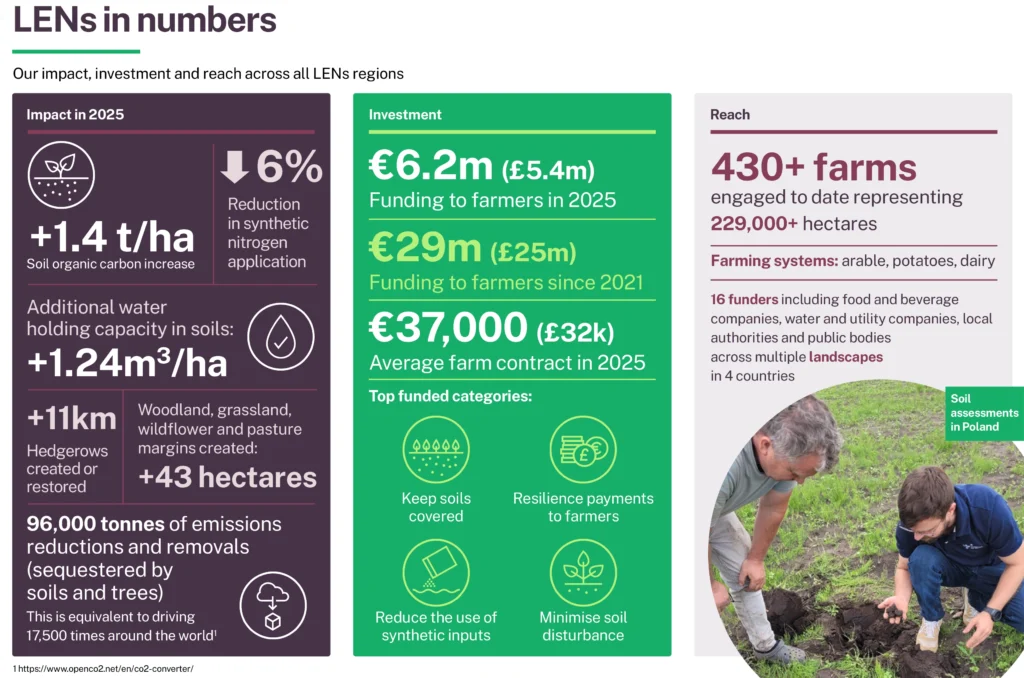
- LENs-supported regenerative practices contributed to 96,000 tonnes CO2e (carbon dioxide equivalent) in emissions reductions and removals, nearly double that of the previous year.
- Soils saw an average increase of 1.4 tonnes of organic carbon per hectare and an additional water-holding capacity of +1.24m3/ha.
- Farms achieved an average reduction of 6% of synthetic nitrogen application in one year.
- Farmers created 43 hectares of woodland, grassland, wildflower and pasture margins and planted or restored 11km of hedgerows, resulting in a 6% score improvement for beneficial insects such as pollinators and natural pest control agents
- Average farm contract – €37,000
Progress in 10 regions
The latest LENs Impact Report has revealed the real, measured impact of building landscape-scale resilience.
Landscape Enterprise Networks (LENs) brings organisations together to co-fund regenerative agriculture and nature-based solutions to drive landscape resilience. Operating since 2021, the latest report looks at 10 regions – East of England, Yorkshire, West Wales, Leven (Scotland), Western Hungary, Veneto and Friuli-Venezia Giulia (Northern Italy) and Greater Poland, Kuyavian–Pomeranian, Lubusz and Warmian–Masurian (Western Poland).
The programme unites farmers, food and beverage companies, water companies and local governments into a single collaborative network designed to protect entire catchments and sourcing regions.
Real, measured impact
The 2025 data, which is based on measured impact rather than projections, confirms that building resilience goes hand-in-hand with commercial stability. While improving soil health, biodiversity and water quality, participating farmers were able to reduce their use of synthetic fertilisers and pesticides and save £140 per hectare. These vital savings included a 6% annual reduction in synthetic nitrogen application, all while crop yields remained comfortably above regional averages.
Economic resilience and environmental sustainability must be treated as a single, shared goal. By joining forces and co-funding nature-based solutions across entire landscapes, we can actively protect our supply chains, catchments, and farming communities from escalating climate volatility. This latest LENs Impact Report proves that by pooling resources, systemic agricultural resilience is achievable.
Donald Lunan, LENs CEO
The scale of this resilient network has expanded rapidly, now encompassing 320 active farms across more than 229,000 hectares in the UK, Italy, Poland, and Hungary, with further expansions actively being established in Ireland and Australia.
Many things we do with LENs are about working with the river rather than fighting it…I have a 10-year scheme for willow planting [and] we’ve planted 100 trees along the river. It stabilised the riverbank and provided shading. We have large grass buffers along the bank and apply no products anywhere near the river to avoid pollution going into the water. Without some support, I just wouldn’t have done it.
Richard Maddever, LENs-funded farmer, East of England
Pooled funding
By pooling funds from 16 major commercial and public investors, the programme significantly de-risks the regenerative transition. For instance, within our Yorkshire region, every €1 invested by a single organisation successfully leveraged an additional €5 from other regional co-funders to maximise landscape-scale defence against shared climate risks.
Since 2021, we’ve partnered with LENs across four countries to help farmers transition to more regenerative practices, aiming at improving soil health and fertility, water and biodiversity, but also capturing carbon. Ultimately, it is enhancing more resilient farming systems which are critical to help secure the ingredients we’ll need in the future.
Cécile Doinel, Regenerative Agriculture Lead, Nestlé Purina Petcare Europe
The operational efficiency of the model ensures that 70 cents of every euro invested goes directly to funding farmers for practical on-the-ground interventions. The remaining 30 cents covers professional agronomic advice, contracting, and our best-in-class measurement, reporting, and verification (MRV) systems.
Our interventions help farmed landscapes to better handle droughts, floods, pest outbreaks, input scarcity, price volatility, and climate uncertainty. We can’t solve environmental issues one farm at a time. To save our soil, protect wildlife, and grow food sustainably, we have to stop working in silos and start tackling entire landscapes together.
Cat Wallis, LENs Impact Director