Chocolate may be one of life’s greatest pleasures, but its future is looking increasingly uncertain. Cocoa is under growing threat from climate change, disease, and market volatility. Increasing the resilience of cocoa supply chains is essential for the future of the global chocolate industry and for the millions of smallholder farmers whose livelihoods depend on it. So, what can the wider food sector learn from the lessons of cocoa supply chain disruption?
A fragile crop in a changing climate
Cocoa thrives under very specific environmental conditions: temperatures between 18–32°C, high humidity, and steady rainfall. These are found mainly within a narrow band near the equator. With over half of the world’s cocoa coming from Cote D’Ivoire and Ghana, global cocoa markets are acutely vulnerable to disruptions in this region. As global temperatures rise and rainfall patterns shift, these regions may become less viable to grow cocoa at all.
In addition to these environmental issues is the poverty the majority of cocoa farmers face. Power imbalances and price squeezes mean that farmers are often left with little return for their product, leaving them unable to secure a living income and to adapt to an increasingly challenging cocoa-growing environment. .
The overall picture is one of a fragile supply base – which has become visible in an increasingly volatile supply chain.
Cocoa markets in crisis
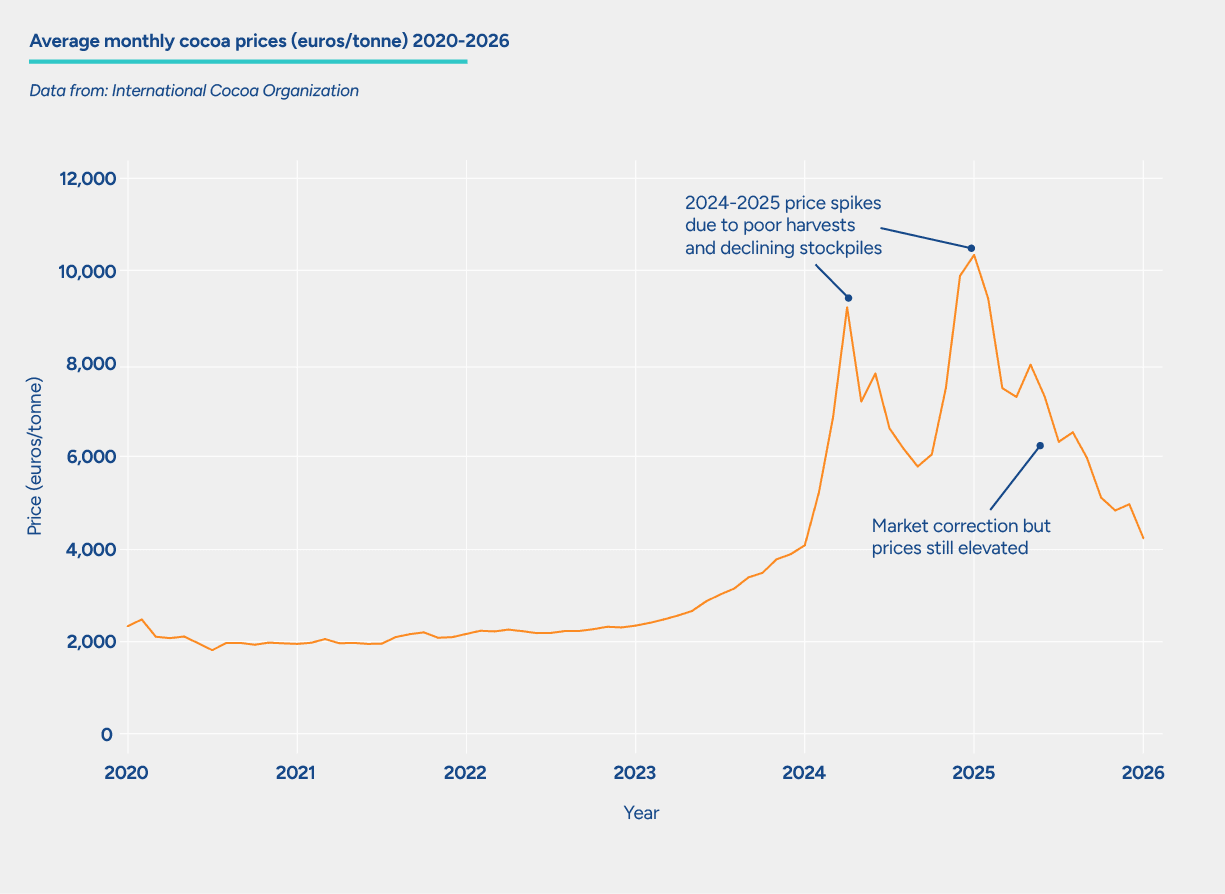
In 2023 and 2024, pressures on cocoa crops collided. Extreme weather and the spread of diseases linked to higher rainfall combined to deliver one of the poorest harvests in decades: yields in some regions were down by roughly one-third compared with prior years. Meanwhile, cocoa stockpiles continued to decline. This supply shock led to high prices in 2024, extending into 2025. Companies faced supply shortages and profit squeeze. Some manufacturers scrambled to fill gaps with spot purchases from alternative suppliers, while others began to reformulate to reduce cocoa usage or invest in novel solutions, such as cocoa alternatives, to help future-proof supply.
Later in 2025, we saw a market correction with demand softening as chocolate manufacturers adjusted to higher costs, while some regions’ production recovered. However, the vulnerability of cocoa supply chains due to the structural challenges of climate sensitivity and social pressures on farming communities remains unresolved. While in 2026 the market is more balanced, global prices are still elevated above previous normal levels. The clear exposure of the cocoa supply chain to shocks demonstrates the need for collective effort to build more resilient, climate-smart cocoa supply chains that can weather environmental shocks while supporting the livelihoods of smallholder farmers.
Return to business as usual should not be the goal
Too often, resilience is equated with returning to the status quo. However, for millions of cocoa farmers in countries like Côte d’Ivoire and Ghana, the status quo already means living on the edge of poverty, with repeated exposure to climate shocks and price volatility. Maintaining these conditions should not be equated to resilience. Given the current fragility of cocoa supply chains, we must see a significant transformation in cocoa to make it more resilient to shocks, both at the local farm level and the global supply chain level. The past few years should serve as a warning signal: invest now to prevent greater disruption in the future.
Charting a better way forward
Companies need to understand the risks in their own supply chain and develop strategies to withstand shocks. Cocoa is especially challenging, given its vast smallholder base and aggregation at the trader level. However, it is by no means unique, and addressing increased levels of climate-induced volatility and the challenge of balancing investment in traceability with rising costs and supply constraints offer lessons for other commodities. The first step is understanding the supply base. The incoming EU Deforestation Regulation has triggered significant investment in cocoa traceability, with more data than ever to identify the production location and the supply chain actors involved. 3Keel has nearly a decade of experience assessing the environmental and human rights commitments and action plans of major cocoa traders. Over this time, traders have focused their efforts on certification schemes and boosting on-farm productivity. These are welcome steps, but have fallen short of creating systemic change or a genuinely sustainable supply chain. Much of the industry is still lagging behind with voluntary sustainability commitments by traders covering less than one-third of global exports. This leaves wide gaps in traceability and accountability, particularly across indirect supply chains. The overall lack of progress on human rights and environmental metrics, and the knock-on impacts that this has had on cocoa prices and supply, indicates that a broader, more innovative range of interventions must be considered to steer cocoa towards a resilient future.
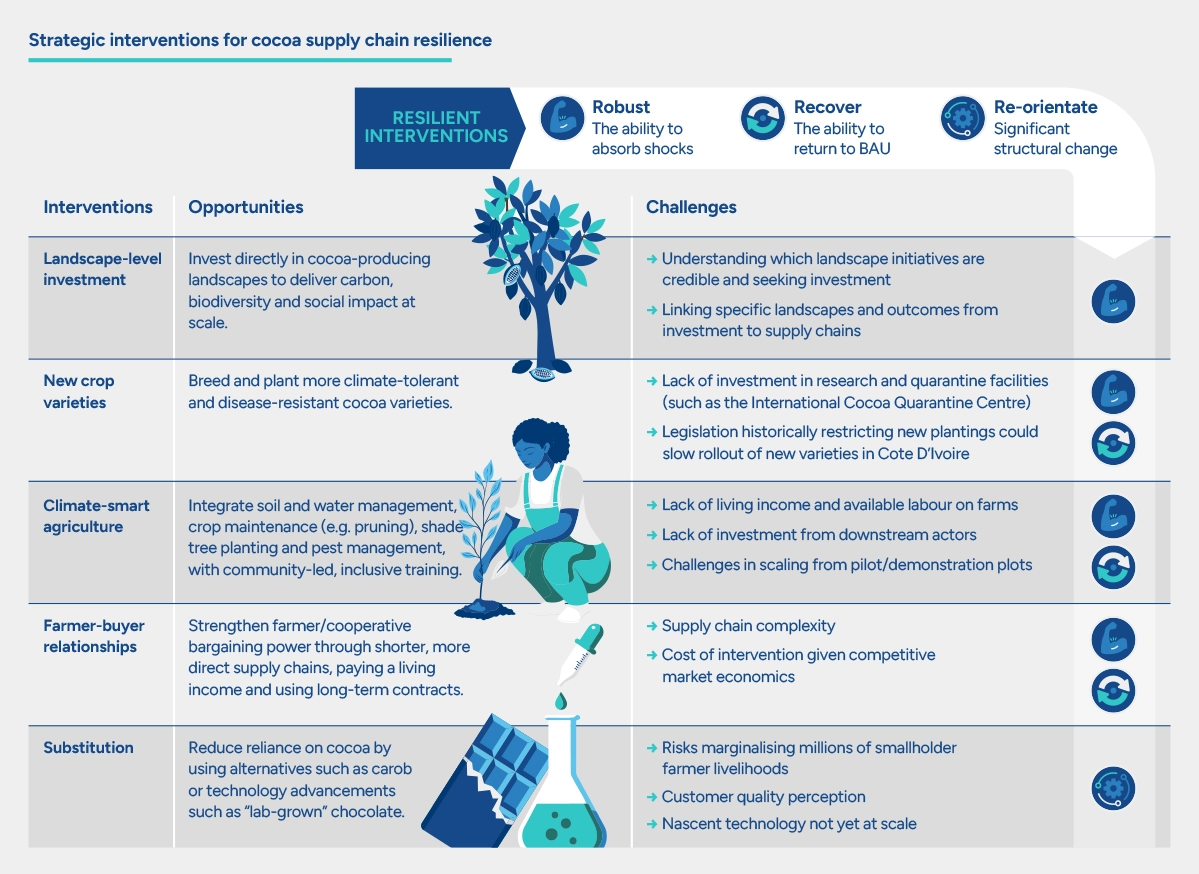
Direct investments in cocoa production can result in a positive feedback loop of increased adaptive capacity and yield at the farm level, while supply chain measures can also help maintain security of supply. At the 2026 World Cocoa Foundation partnership meeting in February, the call was clear: producers, traders, brands, and retailers must deepen collaboration and investment across cocoa supply chains. Promising solutions are now emerging, from income accelerator programs that scale good agricultural practices, to public-private partnerships investing in child labour monitoring and national mapping databases, to linking landscape investments in cocoa regions with corporate carbon reduction goals. The momentum is real—and there is hope we’ll see more transformative change in this critical decade.
True resilience goes beyond recovering from a bad season
Transforming the global cocoa supply chain to be more resilient requires a whole-systems approach that considers farmer livelihoods, national government policy, and the various climate, market, and global political shocks that affect them, while avoiding narrow fixes that solve one issue but worsen others. For companies working in cocoa, it means reorienting strategy beyond short-term supply concerns and recognising that systemic change is unavoidable. Coordinated, industry-wide collaboration, which puts living incomes for cocoa farmers at the centre, will be essential to drive the long-term, structural changes the cocoa sector needs.
The shocks felt in cocoa have demonstrated how fragile our global food supply chains are to climate change and interlinked social issues. While each supply chain is unique, there are lessons to draw for agricultural supply chains across all regions and sectors. Businesses cannot afford to ignore the early warning signal of cocoa. They must embed resilience into their decision-making and make changes now, to challenge short-termism and start to build a system for long-term food security.
We work with businesses in building transparent and resilient supply chains. We specialise in managing deforestation risks, with experience in navigating the complex social and environmental interactions associated with forest-risk commodities such as cocoa. Contact us at commodities@3keel.com or using the form below to find out more about how to assess and increase resilience in cocoa supply chains