Principal Consultant Rob Kilgour explores the current state of the UK food system and considers how we can enhance its resilience.
Over the past few years, ‘tipping points’ – the notion of the climate system crossing a critical threshold that leads to irreversible changes – have risen in prominence as researchers have sought to better understand whether key mechanisms in the environmental systems we rely on will suddenly degrade and lead to major, global impacts. However, the concept is applicable to many other complex, non-linear systems and it feels particularly pertinent in the current discourse on the lack of resilience of the UK food system. Indeed, there seems to have been a recent realisation inside the Government that the UK’s food security and resilience are major vulnerabilities that have not been sufficiently addressed, despite the past declaration that food is one of 13 critical national infrastructure sectors.
For many working inside the food sector this realisation, alongside the challenges of ‘keeping the lights on’, is not new. Following the disruption wrought by Covid-19, our food system has lurched from challenge to challenge. It has been battered by environmental, geopolitical and political events, from some of the driest springs and wettest winters on record, to the Hormuz crisis of 2026, alongside inconsistent and unexpected policy implementation, such as the recent SFI allocation round. A recent National Audit Office (NAO) report on the resilience of the UK food system hammered home that, in this challenging operating environment, the government has work to do to improve the food system’s resilience and, up to now, there has been a heavy reliance on the the private sector for mounting the necessary responses to disruption.
Tipping points aren’t yet leading to action
Given the increasing realisation within government that our food supply is both inherently fragile and a vital pillar of society, one might expect a change in approach and for action to ensue. The NAO report highlights that DEFRA has work underway to improve its approach. However, for those who have been around for a while, such a declaration that we have hopefully, finally, definitely reached a tipping point of realising the need for sustainability and of the fragility in the food system, we have heard this story before. To date, there have been various declared tipping points in food systems, climate change and nature, and yet none have yielded the change required. And so, reacting with cynicism is understandable – it is after all the hope that kills us. Nevertheless, I would argue that the current confluence of events and trends is distinct. Indeed, while ‘resilience’ has been somewhat weaponised as the new conference title of choice, the fact it has caught on as the zeitgeist demonstrates its relevance for many stakeholders in the food system and our current operating environment.
Working in a degrading system
At a Treasury Select Committee in September, Andrew Bailey, the Governor of the Bank of England, was peppered with questions by MPs. It was notable because the impact of a fragile food system on the economy and national inflation was raised several times, both in the macro and micro. Bailey identified food inflation as a short-term upside risk to inflation and was questioned by MPs about farmers being forced to sell Welsh lambs earlier than usual due to feedstock shortages. Sitting behind these discussions were two key stressors on UK food: 1) the impact of rising energy prices on businesses and production; and 2) the UK drought this summer and the potential future impact of this year’s El Niño. The simultaneous impact of these two geopolitical and environmental events is emblematic of the challenges facing the UK food system.
The government has work to do to improve the food system’s resilience and, up to now, there has been a heavy reliance on the the private sector for mounting the necessary responses to disruption.
Pressure increasing globally
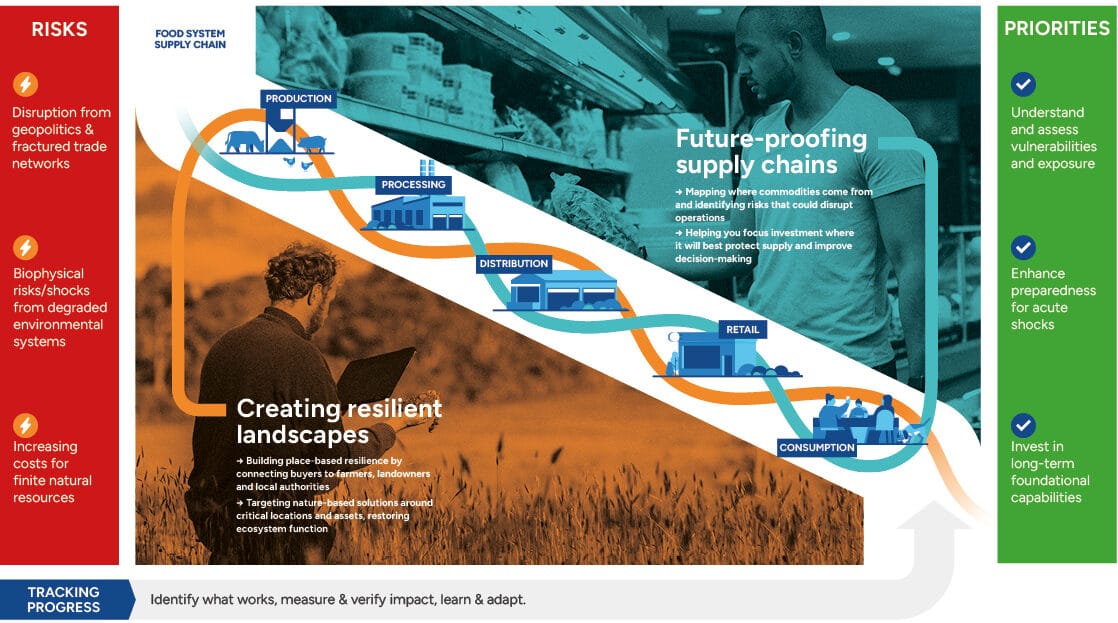
From a geopolitical and socio-economic perspective, the major themes of increasingly fractured trade networks, AI-driven disruption and geopolitical instability as a result of conflict have dominated recent months and years. The World Bank’s composite commodity index highlights that this decade has been the most volatile since the 1970s. The impact of AI on capital markets, the economy and work is another sign of the times. While the macro implications, as well as the sustainability, of AI are best covered separately, ever increasing cyber risk is an obvious and direct challenge that the UK food system has already experienced. Amongst all this, the impact of the Hormuz crisis has been significant. A quarter of urea, a key fertiliser, transits through the Hormuz strait annually and it hit its highest price since 2022 in April 2026. Forecasting the price of oil in the next 12 months is anyone’s guess, as even JP Morgan’s analysts admitted recently, but it is clear that from prices of fertiliser and red diesel for farmers through to fuel and energy costs for manufacturers and retailers, we will all feel the impact in food inflation in the next 12 months.
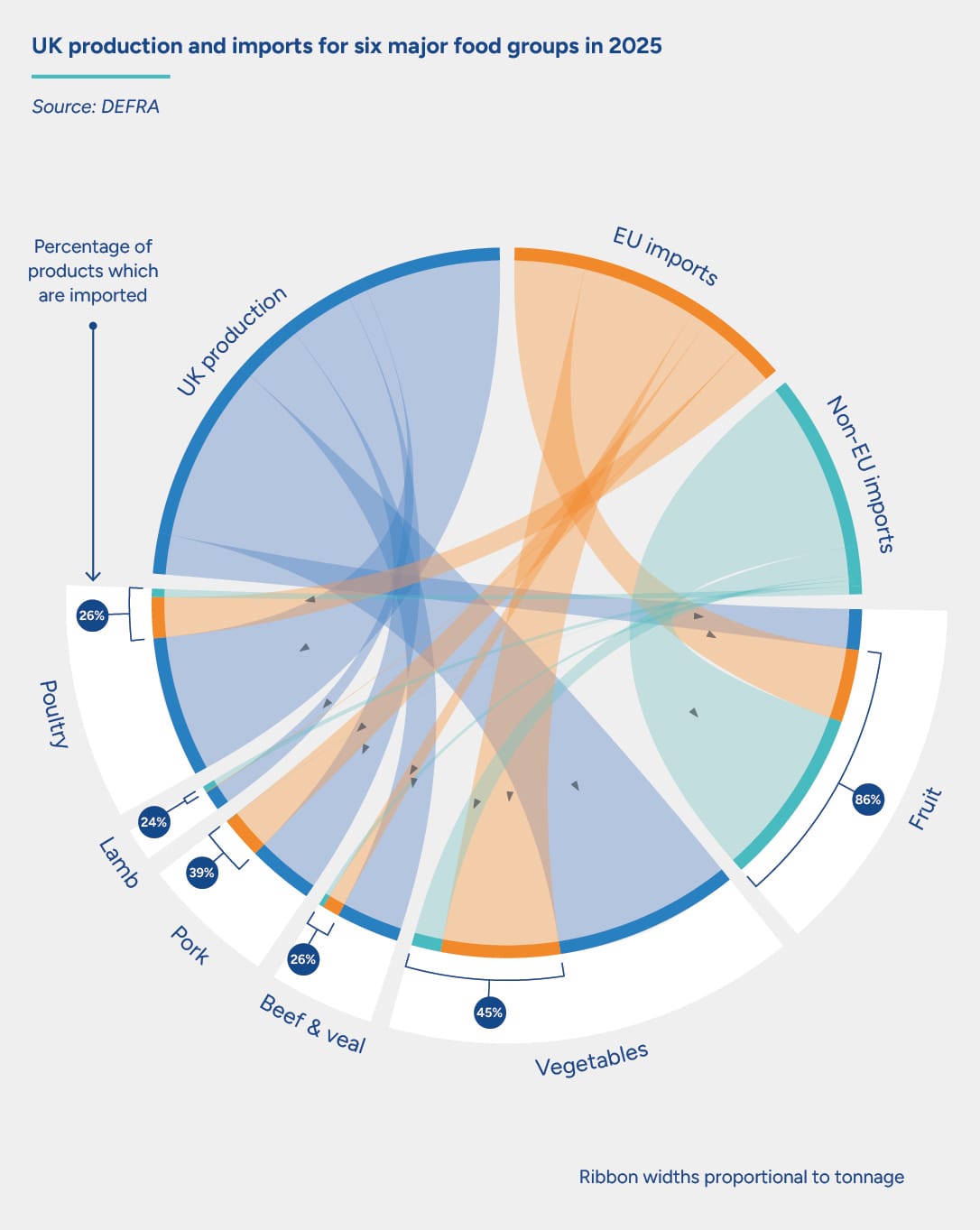
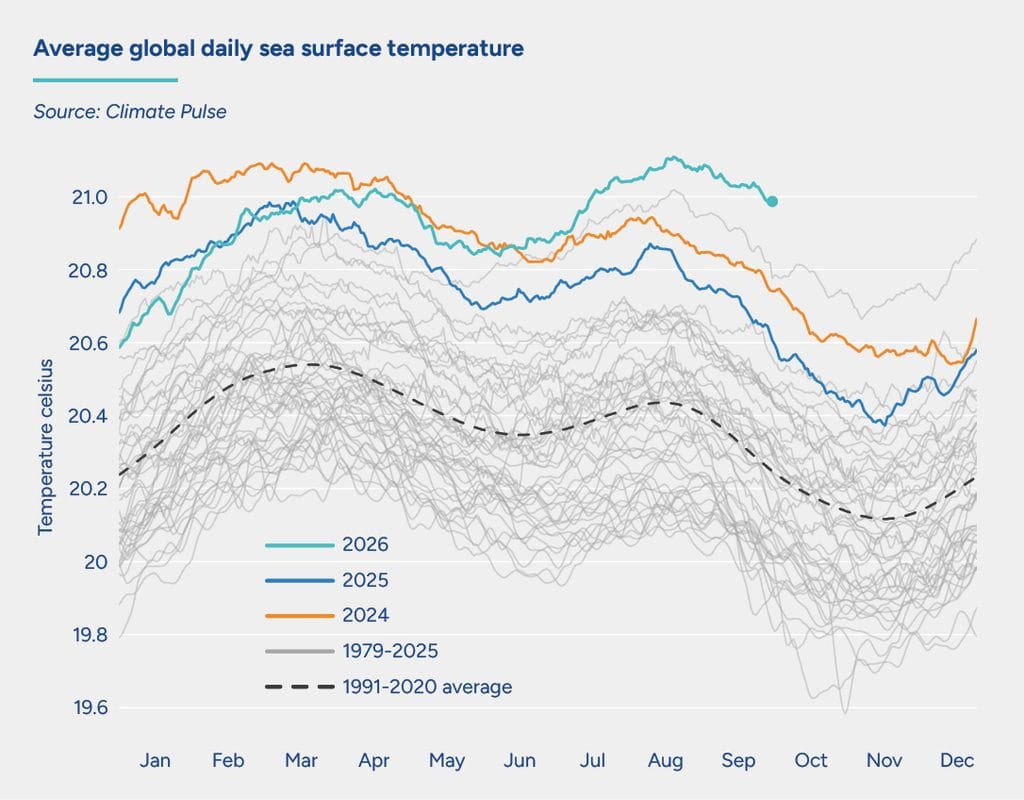
Turning to the environment, the UK’s drought and five successive heatwaves this summer have represented a major stressor on an already stressed agricultural system. 2026 was the hottest summer since records began and impacts were felt across the UK, with the Environment Agency putting in place over 1,500 abstraction restrictions. UK wheat yields for 2026 are 12% below the five year average and across Europe extreme heat was responsible for the loss of 3.1 million tonnes of potatoes, which is expected to have a significant impact on prices in the next year. Sea surface temperatures, an indicator of climate change, also hit the highest level ever recorded, as a very strong El Niño cycle began to emerge. This will almost certainly have an impact on global food supply chains, on which the UK is highly dependent (we import approximately 50% of our food), and it seems likely that the production of certain key global commodities with localised production (e.g. coffee or cocoa) could be significantly impacted.
Where and how can we intervene?
This all represents a rather bleak picture and it raises a key question for both the sector and the government: where and how should we intervene to enhance the integrity of our food system?
Before diving into that question though, it is worth stepping back to consider what we mean by resilience. Definitions range from the relatively orthodox view that it is the capacity to absorb, recover, and adapt to shocks, through to the more heterodox view that it is the capacity to reorganise and fundamentally transform the system. Given the challenges we face, I’d argue that it is clear, and increasingly more widely accepted in the sector, that the latter is closer to where resilience needs to be. Fundamentally, resilience should be about the continuity of supply (i.e. whether we can feed people) in a stressed system, where those stressors and the associated vulnerabilities are known and must be addressed by shifting how we produce things and what we consume.
From prices of fertiliser and red diesel for farmers through to fuel and energy costs for manufacturers and retailers, we will all feel the impact in food inflation in the next 12 months.
Pragmatic thinking required
Turning back to the original question, it follows that the solutions we implement must address one or both of those two challenges: enhancing our preparedness and ability to absorb shocks, and reducing systemic vulnerabilities. This is a big challenge and anyone expecting a sudden influx of cash from the Government to fund stockpiling and wholesale transformation of production systems, will likely be disappointed. The UK is in straitened fiscal times with national debt servicing costs hovering around £110bn. As Chancellor John Healey has said, this is equivalent to the second largest government department by spend after health. With a variety of competing priorities from health and social care to national security, the Government is unlikely to suddenly find the funds required to transform the food system. This is not to say that investment will not be forthcoming, but it is unlikely to be of the magnitude that many of us would like.
Assuming that this turns out to be the case, we must return to the point made by the NAO in its review – the private sector currently plays a major role in food security and resilience. This is unlikely to change in the near-term and a significant burden will fall on the private sector to enhance our food security. The Government should recognise this and act as a reliable partner by facilitating and enabling urgently required action. This means listening to UK food businesses and farmers, and co-developing solutions that can scale beyond pilot and become embedded in how the sector operates.
We need to establish a much more stable, long-term vision of UK food production, consumption and the trade policy that flows from it.
This means learning from other sectors and thinking pragmatically about the system’s preparedness and how to build contingency plans, and the necessary governance and structures around them. The recent announcement of a ‘Food Preparedness Group’ by the Government is a step in the right direction. We also need to establish a much more stable, long-term vision of UK food production, consumption and the trade policy that flows from it. This is key if we are to deftly navigate the transition to a more resilient, sustainable, and nutritious food system. The devolution agenda offers real opportunity. Much of the art of creating a resilient food system will be rooted in place, reflecting the needs and realities of local landscapes and communities. ‘Place-based resilience’ can better foster both environmental and social outcomes, particularly by working across sectors where shared interests exist. Creating the appropriate forums and delivery mechanisms for this cross-sector and public-private collaboration has been and will continue to be a key theme of 3Keel’s work.
Don’t abandon sustainability in the pivot to resilience
Finally, it’s worth revisiting the definition of resilience above and the pursuit of a more resilient, sustainable and nutritious food system. The current embrace of resilience as a concept has unfortunately somewhat supplanted sustainability and led to significant concerns of greenwashing and potential abandonment of impact mitigation. For anyone who understands the food system and the challenges we face, it is clear that a properly resilient food system is not achievable without also addressing the crumbling foundations on which it is built – the environment and a stable climate. Advocating for a pivot to resilience while abandoning sustainability is cognitively dissonant, particularly in the long-term. For an individual business, there is a short-term competitive advantage in being more resilient than competitors. I’d freely endorse this as a rationale for more action. However, we will achieve long-term food system resilience only through collaboration and innovation, not by acting alone. In that respect, there’s significant opportunity ahead in the food system. We just have to seize it and that’s what we’ll be trying to do at 3Keel if you want to join us.